In vitro propagation of Annona deceptrix (westra) H. Rainer (Annonaceae), an endangered species in Ecuador
Authors
- María Auxiliadora Nevárez Loor , Instituto de Posgrado, Universidad Técnica de Manabí, Portoviejo, Ecuador
-
Fátima Consuelo Macías Ponce
Facultad de Ingeniería Agronómica, Universidad Técnica de Manabí. Km. 13.5 vía Portoviejo-Santa Ana. Manabí, Ecuador
 https://orcid.org/0000-0001-5090-5252
-
José Pico-Mendoza
Facultad de Ingeniería Agronómica, Universidad Técnica de Manabí. Km. 13.5 vía Portoviejo-Santa Ana. Manabí, Ecuador
https://orcid.org/0000-0002-3276-1678
DOI:
https://doi.org/10.70099/BJ/2024.01.01.17Keywords:
Annona deceptrix, propagation, in vitro rooting, ex-vitro acclimatization, growth regulatorsAbstract
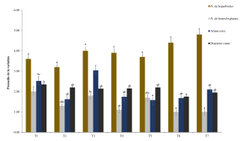
This work aims to develop a protocol for the in vitro propagation of Annona deceptrix (westra) H. Rainer. In addition, it measures survival in ex-vitro conditions. Nodal shoot segments were used as explants, disinfected with different NaClO concentrations and exposure times, and then precultured in the Murashige and Skoog (MS) basal culture medium. Woody Plant Medium (WPM) was used for the multiplication and root-ing phase, with different types and concentrations of phytoregulators. In the establishment phase, the ex-plants responded better with the 1% NaClO treatment for 15 minutes, where the highest survival percentage was observed at 72.04%. For the variable number of shoots and stem diameter, the treatment with BAP (1 mgL-1) + (GA3 0.25 gL-1) + (WPM) reached the best average with a value of 2.00 and 2.35, respectively. Mm, respectively. For root induction, the best response was obtained when 3mgL-1 IBA (T3) was added to the culture medium, reaching an average root length of 5.75 cm after 60 days of culture in the medium. The rooted Vitro plants of an approximate height of 5 cm were brought to the mesh house for their acclimatization; in this phase, the survival rate was evaluated during the first week of acclimatization, and the plant's growth fifteen days after sowing in trays containing a peat-based substrate, where T3 had an average survival of 70% and higher plant height at 60 days, indicating that this treatment promoted faster seedling development under conditions ex-vitro.
References
1. Espinoza C, De la Cruz M, Luzuriaga L, Escudero A. Bosques tropicales secos de la región Pacífico Ecuatorial: diversidad, estructura, funcionamiento e implicaciones para la conservación. Asoc Españo-la ade Ecol Terr. 2012;21(1):167–79.
2. León S, Valencia R, Pitman N, Endara L, Ulloa C, Navarrete H. Libro rojo de las plantas endémicas del Ecuador [Internet]. 2da ed. Quinto: Publicaciones del Herbario QCA, Pontificia Universidad Ca-tólica del Ecuador; 2019. Available from: https://bioweb.bio/floraweb/librorojo
3. Jimenez A, Tapia M, Cabrera C, Pionce G. Investigaciones de Pregrado sobre la Ecología del Bosque Seco Tropical. Runaiki. Manabí; 2020. 129 p.
4. Erkens R. Annona deceptrix . The IUCN Red List of Threatened Species 2021: e.T42828A176434191. 2021;
5. Pico J, Pinoargote M, Madrid L, Flor J, Álava J, Sancán G, et al. Germination Capacity of Annona deceptrix (Westra) H. Rainer (Annonaceae) an Endemic and Endangered Species in Manabí, Ecuador. Indian J Agric Res. 2020;54(3):329–35.
6. Lobo M, Delgado O, Régulo J, Fernández E, Medina C. Categorización de la germinación y la laten-cia en semillas de chirimoya ( Annona cherimola L .) y guanábana ( Annona muricata L .), como apoyo a programas de conservación de germoplasma. Agron Colomb [Internet]. 2007;25(2):231–44. Availa-ble from: http://www.redalyc.org/articulo.oa?id=180320296005
7. Puc C, Cituk D, Villanieva C, Pinzón L. Compatibilidad de injertación en tres clones de guanábana. Agroproductividad. 2018;11(10):71–4.
8. García L, Álvarez J, Alvarado Y, González M, La O M, Mirabal D, et al. Establecimiento in vitro de segmentos nodales de plantas jóvenes de Annona muricata L. Biotecnol Veg. 2012;12(4):229–34.
9. Shekhawat M, Kannan N, Manokari M, Ravindran C. In vitro regeneration of shoots and ex vitro rooting of an important medicinal plant Passiflora foetida L. through nodal segment cultures. J Genet Eng Biotechnol [Internet]. 2015;13(2):209–14. Available from: http://dx.doi.org/10.1016/j.jgeb.2015.08.002
10. Jiménez A, Zhindón B, Indacochea B, Ramos M. explantation disinfection protocols micropropaga-tion of Cedrela odorata L . UNESUM-Ciencias Rev Científica Multidiscip. 2017;1(2):1–6.
11. Ramírez M, Urdeta A, León de Sierralta S. Establecimiento in vitro de explantes adultos del guaná-bano (Annona muricata L.) tratados con hipoclorito de sodio. Rev la Fac Agron [Internet]. 2002;19(1):48–55. Available from: http://ve.scielo.org/scielo.php?script=sci_arttext&pid=S0378-78182002000100005&lng=es&nrm=iso
12. López P, Iracheta L, Castellanos M, Méndez I, Francisco J, Gutiérrez A, et al. Campo Experimental Rosario Izapa. INIFAP. Carretera Tapachula-Cacahoatan, km 18. Rev Mex Ciencias Agrícolas. 2011;2:645–57.
13. Echenique M, Mollo A. Establecimiento in vitro de segmentos nodales de guanabana (annona murica-ta l.) En la estación experimental sapecho - bolivia. Rev Investig e Innovación Agropecu y Recur Nat [Internet]. 2020;7(1):62–8. Available from: http://www.scielo.org.bo/pdf/riiarn/v7n1/v7n1_a09.pdf
14. Solis L, Olivera S, Rosa R. Propagación in vitro de Carica papaya var. PTM-331 a partir de meriste-mos apicales. Rev Peru Biol. 2011;18(3):343–7.
15. Ahmed A, Al-Olayan E, Aboul M, Al-Khedhairy A. The immune enhancer, thymoquinone, and the hope of utilizing the immune system of Aedes caspius against disease agents. African J Biotechnol. 2010;9(21):3183–95.
16. Ba O, Dieme A, Ndoye AL, Sy MO. In Vitro Clonal Propagation from Juvenile and Different Ex-plant Types of Two Edible Annonaceae Species: Annona muricata L. and Annona squamosa L. Adv Biosci Biotechnol. 2021;12(12):458–80.
17. Nagori R, Purohit SD. In vitro plantlet regeneration in Annona squamosa through direct shoot bud differentiation on hypocotyl segments. Sci Hortic (Amsterdam). 2004;99(1):89–98.
18. Therezan R, Paiva R, Silva L. In vitro culture of Annona emarginata : A rootstock for commercial an-nonaceae species Cultivo in vitro de Annona emarginata : Porta-enxerto para espécies de anónaceas comerciais In vitro culture of Annona emarginata : A rootstock for commercial annonaceae. Plant cell Cult y Micropropag. 2016;12(1):1–6.
19. Mollohuanca C, Mayta L, Bardales R. Growth Regulators (BAP and ANA) for in vitro Propagation of Queñoa (Polylepis rugulosa Bitter). Manglar. 2021;18(2):207–13.
20. Cob J, Ríos D, María A, Cartes P, Sánchez M. Organogénesis directa para la propagación in vitro de Quillaja saponaria Molina en Sudamérica Austral. Rev Mex Ciencias For. 2017;7(34):057–67.
21. Jovanovic M, Lefebvre R, Laporte P, Rizzo S, Frugier F, Brie C, et al. How the Environment Regu-lates Root Architecture in Dicots I . Introduction. Adv Bot Res. 2008;35–74.
22. Ramos R, Canchignia H. Propagación de Guanábana (Annona muricata) utilizando ANA (Ácido Naf-talenacético) y AIB (Ácido Indolbutírico) en el Cantón Quevedo año 2015 [Internet]. Universidad Técnica Estatal de Quevedo; 2016. Available from: chrome-exten-sion://efaidnbmnnnibpcajpcglclefindmkaj/https://repositorio.uteq.edu.ec/bitstream/43000/4314/1/T-UTEQ .0247.pdf
23. Jordán M, Casaretto J. Hormonas y Reguladores del Crecimiento : Auxinas , Giberelinas y Citocininas. In: Fisiología Vegetal [Internet]. Universida. La Serena, Chile; 2006. p. 1–28. Available from: chrome-exten-sion://efaidnbmnnnibpcajpcglclefindmkaj/https://exa.unne.edu.ar/biologia/fisiologia.vegetal/Auxinasgiberelinasycitocininas.pdf
24. Pérez V, Panduro N, Sánchez J, Chuyma M, Villegas P. Indolbutírico en el enraizamiento de estaqui-llas de annona muricata « guanábana » en cámara de subirrigación. Folia Amaz. 2019;28(1):33–41.
25. Cárdenas C, Pacheco J, Vanzela A. Propagación in vitro de Solanum dolichosepalum ( Solanaceae ). 2016;7(2):9–22.
26. Castro D, Sánchez G. Propagación clonal in vitro de eucalyptus pellita f. Muell a partir de árboles plus. Temas Agrar. 2010;15(1):34–43.
27. Pedrotti E, Voltolini J. Enraizamento ex vitro e aclimatização do porta-enxerto de macieira m.9. Rev Bras Frutic Jaboticabal. 2001;23(2):234–9.
Published
How to Cite
Issue
Section
Categories
License

This work is licensed under a Creative Commons Attribution 4.0 International License.
Authors who publish with BioNatura Journal agree to the following terms: Authors retain copyright and grant the BioNatura Institutional Publishing Consortium (BIPC) right of first publication with the work simultaneously licensed under a Creative Commons Attribution 4.0 International License (CC BY 4.0). This allows others to share the work with an acknowledgment of the work's authorship and initial publication in this journal.This is an open access article distributed under the terms of the Creative Commons Attribution 4.0 International License (CC BY 4.0), which permits unrestricted use, distribution, and reproduction in any medium, provided the original work is properly cited.


