Approach before alcoholic fermentation of mixtures with syrup in a Cuban distillery
Autores/as
-
Yailet Albernas Carvajal
Departamento de Ingeniería Química, Facultad de Química y Farmacia, Universidad Central “Marta Abreu” de Las Villas, Santa Clara / Cuba
 https://orcid.org/0000-0003-4363-4401
-
Yodalys Lamas Pérez
Empresa Agroindustrial Azucarera “Heriberto Duquesne”, Remedios / Cuba
https://orcid.org/0009-0006-1642-3157
-
Ana Celia de Armas Martínez
Empresa de Bebidas y Refrescos, Villa Clara / Santa Clara /Cuba
https://orcid.org/0000-0002-0147-0704
-
Irenia Gallardo Aguilar
Departamento de Ingeniería Química, Facultad de Química y Farmacia, Universidad Central “Marta Abreu” de Las Villas, Santa Clara / Cuba
https://orcid.org/0000-0002-6360-6582
DOI:
https://doi.org/10.70099/BJ/2024.01.04.17Palabras clave:
experiment design, mixture, fermentation, syrup, substrateResumen
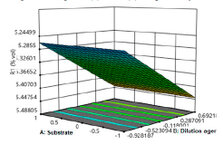
Because of the competition with final molasses in different productions, it is necessary to look for other sources of sugar substrates to obtain ethanol. Streams derived from sugar production, such as final molasses, syrup, or filter juice, contain fermentable sugars, representing an opportunity for ethanol production. This work conducted a preliminary study in the alcoholic fermentation stage using a mixture of filter juice, molasses, and syrup. It also analyzed the feasibility of using syrup as a raw ferment material obtained from low-quality sugarcane. The experimental study was carried out using a 2k-1 experimental design, considering as variables: substrate (molasses or syrup), dilution agent (water and filter juice), and type of acid (H2SO4 and H3PO4), and the response variable was the alcoholic percentage obtained. Syrup, diluted with water using H3PO4, is a viable option when low-quality sugarcane is present, allowing the alcoholic degrees between 5.45 and 5.47%. With filter juice, alcoholic degrees between 5.22 and 5.30% were obtained, which are lower than in other studies with filter juices from sugarcane of adequate quality. The most influential variables were the dilution and acidifying agents in the statistical model obtained using Statgraphics Centurion XV 15.1.0.2 software.
Citas
1. Aruwajoye G.S, Rorke D, Sanusi I.A, Sewsynker-Sukai Y, Gueguim E. Bioethanol Production Using Novel Starch Sources. Home Bioethanol: A Green Energy Substitute for Fossil Fuels; 2023. https://link.springer.com/chapter/10.1007/978-3-031-36542-3_5
2. Ethanol market report. Precedence Research. Chemical and material, 2023 (accessed on August 14, 2024). https://www.precedeneresearch.com/ethanol-market
3. Wani AK, Rahayu F, Fauziah L, Suhara, C. Advances in safe processing of sugarcane and bagasse for the generation of biofuels and bioactive compounds. Journal of Agriculture and Food Research. 2023;12: Article 100549. https://www.sciencedirect.com/science/article/pii/S266615432300056X
4. Hans M, Lugani Y, Chandel AK, Rai R, Kumar S. Production of first- and second-generation ethanol for use in alcohol-based hand sanitizers and disinfectants in India. Biomass Conversion and Biorefinery. 2023;13: 7423-7440. https://doi.org/10.1007/s13399-021-01553-3
5. Cadiz JPR, Agcaoili RP, Mamuad RY, Choi AES. Fermentation of sweet sorghum (Sorghum bicolor L. Moench) using immobilized yeast (saccharomyces cerevisiae) entrapped in calcium alginate beads. Fermentation. 2023;9(3): Article 272. https://doi.org/10.3390/fermentation9030272
6. Pérez-Bermúdez I, Ribas-García M, Ibañez-Fuentes M, Saura-Laria G, Garrido-Carralero N. Análisis de la influencia de la calidad de la miel final y el tiempo perdido sobre la eficiencia industrial en la producción de etanol. ICIDCA Sobre los Derivados de la Caña de Azúcar. 2015;49(2): 58-63. https://www.redalyc.org/articulo.oa?id=223143421009
7. Amanful B, Dogbe ES, Bosman CE, Görgens JF. Stochastic techno-economic analysis for the co-production of alternative sweeteners in sugarcane biorefineries. Food and Bioproducts Processing. 2024;143: 9-20. https://www.sciencedirect.com/science/article/pii/S0960308523001220
8. Albernas Y, Corsano G, Morales M, González M, Santos R., González E. Optimal design for an etanol plant combining first and second generation Technology. Ciencia Tecnología y Futuro. 2014;5(5): 97-120. http://www.scielo.org.co/scielo.php?script=sci_arttext&pid=S0122-53832014000200006
9. de Armas AC. Evaluation of second and third generation biorefinery schemes in a Cuban sugar industry. Doctoral dissertation. Universidad Central “Marta Abreu” de Las Villas, Cuba. 2019.
10. Lamas Y, de Armas AC, Albernas Y, González E. Preliminary analisys of alcoholic fermentation using filter juice, molasses and syrup mixture. Centro Azúcar. 2023;50(3): e1035. http://centroazucar.uclv.edu.cu/index.php/centro_azucar/article/view/767
11. Rojas-Sariol L, Lorenzo-Acosta Y, Domenech-López F. Estudio del consumo de ácidos en el ajuste de pH en diferentes medios de fermentación alcohólica. ICIDCA. Sobre los Derivados de la Caña de Azúcar. 2011;45(2): 57-62. https://www.redalyc.org/pdf/2231/223122259008.pdf
12. Albernas Y, González M, Corsano G, González E. Obtaining superfine ethanol in a Cuban distillery. Ingeniería e Investigación Journal. 2012;32(3): 47-52. http://www.scielo.org.co/scielo.php?script=sci_arttext&pid=S0120-56092012000300010
13. Albernas Y, Corsano G, Kafarov V, González M, González E. Optimal design of pre-fermentation and fermentation stages applying nonlinear programming. Energy Conversion and Management. 2014;87: 1195-1201. https://www.sciencedirect.com/science/article/abs/pii/S019689041400315X
14. González M, Castellanos L, Albernas Y, González E. Process integration in a biorefinery scheme, Afinidad. 2014;71(568): 274-278. https://raco.cat/index.php/afinidad/article/view/287619
15. García R, Pérez A, Diéguez K, Mesa L, González I, González M, González E. Incorporating other substances as raw materials for fermented sugar in alcohol distilleries. Revista Facultad de Ingeniería Universidad de Antioquia. 2015;75: 130-142. https://doi.org/10.17533/udea.redin.n75a13
16. Díaz J. Valoración de alternativas para la obtención de etanol a partir de mezclas de jugos secundarios y melazas en la destilería Jesús Rabí. Master thesis, Universidad de Matanzas, Cuba. 2021. https://rein.umcc.cu/bitstream/handle/123456789/608/MSc21%20Javier.pdf?sequence=1&isAllowed=y
17. Thammasittirong SN-R, Chatwachirawong P, Khemdee, K, Thammasittirong A. Evaluating the potential of newly developed energy cane clones for first- and second-generation ethanol production. Fermentation. 2023;9(3): Article 267. https://doi.org/10.3390/fermentation9030267
18. Saura G. García R, Otero MA, Martínez JA, Bello D, Pérez I. Experiencias en la producción de etanol a partir de jugos de caña mezclados. Parte I. Materias Primas. ICIDCA sobre los derivados de la caña de azúcar. 2009;43(2): 42-46. https://www.redalyc.org/pdf/2231/223120662003.pdf
19. Rivero RP, Morales M, Mesa L. Evaluación económica de la utilización de mezclas de sustratos azucarados para la producción de etanol. Centro Azúcar. 2012;39(4): 29-35. http://centroazucar.uclv.edu.cu/index.php/centro_azucar/article/view/351
20. Martínez Y, González V, Penin E, González E. Preliminary study of the water-vinaza-flemaza mixture and its impact in the fermentation stage in the ethanol production. Tecnología Química. 2013;33(3): 206-211. http://scielo.sld.cu/scielo.php?script=sci_arttext&pid=S2224-61852013000300003
21. de la Cruz R, González E, Abreu A. Alternativas de la combinación de sustratos para la fermentación alcohólica en la destilería anexa al Complejo Agroindustrial Azucarero Melanio Hernández. Centro Azúcar. 2000;27(4): 22-28.
22. Mesa L, González E, González M, Agüero G, Benítez T. Estudio preliminar del mezclado de los sustratos: jugo de los filtros, jugos secundarios y miel en la producción de etanol. Centro Azúcar. 2006;33(4): 32-36.
23. de Armas AC, Lamas Y, Albriza MT, González E. Possibilities of utilization of filter juice in a sugar factory with distillery. El Directivo al Día. 2020;20(2): 27-36.
24. Fabelo JA. Study of the alcoholic fermentation stage using a mixture of different substrates. Doctoral dissertation. Universidad Central “Marta Abreu” de Las Villas, Cuba. 1999.
25. Morales M, Armas A, Mesa L, Acosta D, González E. Avances en el uso del licor hidrolizado de bagazo en la fermentación de mezclas azucaradas. Afinidad. 2018;75(581): 61-65. https://raco.cat/index.php/afinidad/article/view/335964
26. Mesa L, Martínez Y, de Armas AC, González E. Ethanol production from sugarcane straw using different configurations of fermentation and techno-economical evaluation of the best schemes. Renewable Energy. 2020;156: 377-388. https://doi.org/10.1016/j.renene.2020.04.091
27. Pérez A, Zumalacárregui L, Pérez O. Evaluación de tecnologías para la obtención de productos químicos de alto valor agregado y biocombustibles. Universidad y Sociedad. 2023;15(4): 138-153. https://rus.ucf.edu.cu/index.php/rus/article/view/3961
28. Guerra M, Correa Y, Medel F, Martínez L, Pérez, O. Estudio de la fermentación alcohólica con vinculación de otros sustratos. Análisis económico. Centro Azúcar. 1995;22(3): 24-30.
29. Fernández K, Morales Y, Nápoles M, González E, Cruz M. Study of the extraction of secondary juices at the Central Argentina refinery. Centro Azúcar. 2008;28(2): 43-48. http://centroazucar.uclv.edu.cu/index.php/centro_azucar/article/view/507
30. Díaz J, García A, González LY, Luis J, Díaz MLV. Adsorción de impurezas del jugo clarificado de la industria azucarera mediante biomasa pirolizada. Revista Cubana de Química. 2019;31(3): 463-477. https://cubanaquimica.uo.edu.cu/index.php/cq/article/view/5027
31. Ojeda R. Propuesta de introducción de la tecnología de obtención de alcohol orgánico en la destilería del CAI “Heriberto Duquesne”. Chemical Engineering Degree Thesis. Universidad Central “Marta Abreu” de Las Villas, Cuba. 2005. https://dspace.uclv.edu.cu/items/e8c02916-d241-4fc9-a45d-cfdfcabe317b
32. Dogbe ES, Mandegari MA, Görgens JF. Exergetic diagnosis and performance analysis of a typical sugar mill based on Aspen Plus® simulation of the process. Energy. 2018;145: 614-625. https://www.sciencedirect.com/science/article/abs/pii/S0360544217321771
33. Mensah RQ, Yingkamhaeng N, Venkatachalam P, Show P-L, Mussatto SI, Sriariyanun M., Sukyai P, Parakulsuksatid P, Rattanaporn K. Application of green produced xylooligosaccharides from sugarcane residues and their properties – Recent progress towards sustainability. Bioresource Technology Reports, 2023;23: Article 101537. https://www.sciencedirect.com/science/article/abs/pii/S2589014X23002086
34. Carvalho LC, Oliveira ALS, Carsanba E, Pintado M, Oliveira C, Phenolic compounds modulation in β-farnesene fed-batch fermentation using sugarcane syrup as feedstock. Industrial Crops and Products. 2022;188(B): Article 115721. https://www.sciencedirect.com/science/article/abs/pii/S0926669022012043
35. de Armas AC, Morales M, Albernas Y, González E. Projection of a sugar industry to become a biorefinery from second and third generation biofuels. Tecnología Química. 2019;39(3): pp. 489-507. http://scielo.sld.cu/scielo.php?script=sci_arttext&pid=S2224-61852019000300489
36. NC 290: 2007. Norma Cubana Bebidas alcohólicas-Determinación del grado alcohólico en alcoholes, bebidas alcohólicas destiladas, vinos, licores, bebidas alcohólicas preparadas, cocteles y extractos hidroalcohólicos. Oficina Nacional de Normalización. 2007. Available from: https://ftp.isdi.co.cu/Biblioteca/BIBLIOTECA%20UNIVERSITARIA%20DEL%20ISDI/COLECCION%20DIGITAL%20DE%20NORMAS%20CUBANAS/2007/NC%20290%20%20a2007%20%20324p%20twi.pdf
37. NC 709: 2009. Norma Cubana MIEL FINAL - Determinación de sólidos aerométricos disueltos. Oficina Nacional de Normalización. 2009. Available from: https://ftp.isdi.co.cu/Biblioteca/BIBLIOTECA%20UNIVERSITARIA%20DEL%20ISDI/COLECCION%20DIGITAL%20DE%20NORMAS%20CUBANAS/2013/NC%20710%20a2013%2014p%20isp.pdf
38. NC 711: 2009. Determinación potenciométrica del pH. Oficina Nacional de Normalización. 2009. Available from: https://ftp.isdi.co.cu/Biblioteca/BIBLIOTECA%20UNIVERSITARIA%20DEL%20ISDI/COLECCION%20DIGITAL%20DE%20NORMAS%20CUBANAS/2009/NC%20711%20%20a2009%205p%20kal.pdf
39. NC 790: 2010. Bebidas alcohólicas - Determinación del grado alcohólico - métodos de referencia: 1- grado alcohólico por picnometría y 2- grado alcohólico por densimetría dígital. Oficina Nacional de Normalización. 2010. Available from: https://ftp.isdi.co.cu/Biblioteca/BIBLIOTECA%20UNIVERSITARIA%20DEL%20ISDI/COLECCION%20DIGITAL%20DE%20NORMAS%20CUBANAS/2010/NC%20790%20a2010%2011p%20qjc.pdf
40. Cortés MF, de Armas AC, Alomá IC, Morales M. Filter juice extraction impact on an industrial sugar complex sustainability. Centro Azúcar. 2021;48(1): 59-70. http://centroazucar.uclv.edu.cu/index.php/centro_azucar/article/view/642
41. de Armas AC, Albernas Y, Lamas Y, Benítez R, Dueñas A. Fermentación alcohólica de mezclas de jugo de los filtros, miel final y meladura: Estudio preliminar en una destilería cubana. Proceedings of the VI Congreso Internacional de Ingeniería Aplicada in VII Convención Científica Internacional UTM 2023. Portoviejo (Manabí, Ecuador); 2023 Oct 24-27.
42. Sablayrolles J-M. Kinetics and control of alcoholic fermentation during wine production. Chapter of: Yeasts in the production of wine, Springer New York, NY; 2019. p. 283-313. https://doi.org/10.1007/978-1-4939-9782-4_9
43. Ribeiro MLD, Ferreira OE, Teixeira V, Mutton MA, Mutton MJR. Physicochemical treatment of sugarcane juice produces quality cachaça. Agronomic Science Magazine. 2017;48(3): 458-463. https://doi.org/10.5935/1806-6690.20170053
Descargas
Publicado
Cómo citar
Número
Sección
Categorías
Licencia

Esta obra está bajo una licencia internacional Creative Commons Atribución 4.0.
Authors who publish with BioNatura Journal agree to the following terms: Authors retain copyright and grant the BioNatura Institutional Publishing Consortium (BIPC) right of first publication with the work simultaneously licensed under a Creative Commons Attribution 4.0 International License (CC BY 4.0). This allows others to share the work with an acknowledgment of the work's authorship and initial publication in this journal.This is an open access article distributed under the terms of the Creative Commons Attribution 4.0 International License (CC BY 4.0), which permits unrestricted use, distribution, and reproduction in any medium, provided the original work is properly cited.


