Chemical Study and Antioxidant Activity of Lipid Fraction from Bactris gasipaes Kunth (peach palm), a fruit used as food in the Ecuadorian Amazon
DOI:
https://doi.org/10.70099/BJ/2024.01.01.39Keywords:
Bactris gasipaes, DPPH, ABTS, CG- FID, oleic acidAbstract
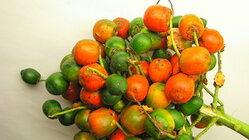
The lipid fraction of the Bactris gasipaes (chonta) fruit was obtained by the soxhlet method using hexane as solvent. The chemical characterization was carried out employing gas chromatography coupled to flame ionization (CG-FID): A total of 12 fatty acids were identified, the main compounds being the acids: oleic (51.75%), palmitic (28.52%), and linoleic ( 9.99%) respectively. In addition, the physical properties of vegetable oil, acidity index (0.003%), iodine (49.43cg/g), refraction (1.479) and peroxides (0.08 meqO2/kg) were evaluated. Finally, its antioxidant activity was assessed by the DPPH method (78.32 µM ET/g) and ABTS (39.59 µM ET/g).
References
Pasquel, A., Del Castillo, A., Sotero, V., & García, D. (2002). Extracción del aceite de la cáscara de Bactris gasipaes HBK usando dióxido de carbono presurizado. Revista Amazónica de Investigación Alimentaria, 2(1), 1–14.
Hooghiemstra, H., Cleef, A., Noldus, C., & M.Kappelle. (2012). Dinámica de la vegetación del Cuaternario superior y paleoclimatología del área del pantano La Chonta (Cordillera de Talamanca, Costa Rica). Revista de ciencia cuaternaria.
Mondragon Diaz, A. F. (2019). Determinación de las características agronómicas de 6 Ecotipos de Pijuayo para Palmito (Bactris Gasipaes K.) con posibilidades de propagación y desarrollo en la zona del Pongo de Caynarachi-San Martín.
Serrano, M., Umaña, G., & Sáenz, M. V. (Diciembre de 2011). Fisiología poscosecha, composición química y capacidad antioxidante de frutas de pejibaye (bactris gasipaes kunth ) cv. Obtenido de Scielo: https://www.scielo.sa.cr/scielo.php?script=sci_arttext&pid=S0377-94242011000200006
Montealegre, Y. (enero de 2020). CARACTERIZACIÓN FISICOQUÍMICA Y NUTRICIONAL DE PASABOCAS DE CHONTADURO (Bactris gasipaes) EMPLEANDO PARA SU ELABORACIÓN DIFERENTES TECNOLOGÍAS DE SECADO. Obtenido de Repository: https://repository.unad.edu.co/bitstream/handle/10596/31888/ymontealegrer.pdf?sequence=1&isAllowed=y
Torrejón, C., & Uauy, R. (2011). Calidad de aceite, arterioesclerosis y enfermedad coronaria: Efectos de los ácidos grasos saturados y ácidos grasos trans. Revista Medica de Chile, 139(7), 924–931. https://doi.org/10.4067/S0034-98872011000700016.
Cabezas-Zábala, C. C., Hernández-Torres, B. C., & Vargas-Zarate, M. (2016). Aceites y aceites: efectos en la salud y regulación mundial. Revista de La Facultad de Medicina, 64(4), 761. https://doi.org/10.15446/revfacmed.v64n4.53684.
Jatunov, S., Quesada, S., Díaz, C., & Murillo, E. (2010). Carotenoid composition and antioxidant activity of the raw and boiled fruit mesocarp of six varieties of Bactris gasipaes. Archivos latinoamericanos de nutrición, 60(1), 99.
Llumiquinga, M. (18 de Marzo de 2021). Análisis del estado actual de Bactris gasipaes Kunth en el Ecuador. Obtenido de ESPE: http://repositorio.espe.edu.ec/xmlui/bitstream/handle/21000/24215/T-ESPE-044451.pdf?sequence=1&isAllowed=y#:~:text=Bactris%20gasipaes%20Kunth%20se%20considera,alimentaci%C3%B3n%20(Mac%C3%ADa%2C%202004).
Brand-Williams, W.; Cuvelier, M.E.; Berset, C. Use of a free radical method to evaluate antioxidant activity. LWT Food Sci. Technol. 1995, 28, 25–30.
Thaipong, K.; Boonprakob, U.; Crosby, K.; Cisneros-Zevallos, L.; Hawkins Byrne, D. Comparison of ABTS, DPPH, FRAP, and ORAC assays for estimating antioxidant activity from guava fruit extracts. J. Food Compos. Anal. 2006, 19, 669–675.
Valarezo, E.; Rivera, J.X.; Coronel, E.; Barzallo, M.A.; Calva, J.; Cartuche, L.; Meneses, M.A. Study of Volatile Secondary Metabolites Present in Piper carpunya Leaves and in the Traditional Ecuadorian Beverage Guaviduca. Plants 2021, 10, 338.
Mujica, F., Viky, C., Rodriguez, M., Lopez, S., & Mendez, D. (2017). Evaluation of oil properties of fruit pulp pijiguao (Bactris Gasipaes H.B.K) for use in cosmetics industry. Ingeniería UC, 24(3), 314–326. Retrieved from https://www.redalyc.org/pdf/707/70754692006.pdf
Córdova, F. (2016). Producción De Biodiesel a Partir De Aceite Vegetal Extraído Del Fruto De La Palma Bactris Gasipaes (Chontaduro) (Universidad Libre). Retrieved from https://repository.unilibre.edu.co/bitstream/handle/10901/9818/Trabajo final Maestria Fausto.pdf?sequence=1
García-Pantaleón, D. M., González, J., Moreno-Álvarez, M. J., Belén-Camacho, D. R., Medina-Martínez, C., & Linares, O. (2006). Características fisicoquímicas del aceite del endospermo de la Palma Yagua (Attalea cryptanther). Aceites y Aceites, 57(3), 308–312.
Restrepo, J., Estupiñán, J. A., & Colmenares, A. J. (2016). Comparative study of lipid fractions from Bactris gasipaes Kunth (peach palm) obtained by soxhlet and supercritic CO2 extraction. Revista Colombiana de Química, 45, 5–9. https://doi.org/http://dx.doi.org/10.5446/rev.colomb.quim.v45nl.57199
Romero, L., Valdiviezo, C., & Bonilla, S. (2019). Characterization of sacha inchi seed oil (plukenetia volubilis) from “Canton San Vicente, Manabí, Ecuador”, obtained by non-thermal extrusion processes. Revista de Ciencia de La Vida, 30(2), 77–87. https://doi.org/http://doi.org/10:17163/lgr.n30.2019.07
Valenzuela, A., & Nieto, S. (2003). Ácidos grasos omega-6 y omega-3 en la nutrición perinatal: su importancia en el desarrollo del sistema nervioso y visual. Revista chilena de pediatría, 74(2), 149-157.
Restrepo, J., Arias, N., & Madriñán, C. (2018). Determination of the Nutritional Value, Fatty Acid Profile and Antioxidant Capacity of Aguaye pulp (Mauritia Flexuosa). Revista de Ciencias Naturales y Exactas, 20(1), 8. https://doi.org/10.25100/rc.v20i1.6109.
Martínez, A. (2011). Evaluación la actividad antioxidante de los aceites y de su fracción insaponificable de los frutos de: Mauritia flexuosa (Morete), Bactris gasipaes (Chonta), Plukenetia volubilis (Sacha inchi) y Oneocarpus batahua (Ungurahua). Universidad Politecnica Salesiana, 131.
Torres, J. (2019). Evaluación de ácidos grasos y actividad antioxidante in vitro del aceite de la semilla de Annona muricata.
Published
How to Cite
Issue
Section
Categories
License

This work is licensed under a Creative Commons Attribution 4.0 International License.
Authors who publish with BioNatura Journal agree to the following terms: Authors retain copyright and grant the BioNatura Institutional Publishing Consortium (BIPC) right of first publication with the work simultaneously licensed under a Creative Commons Attribution 4.0 International License (CC BY 4.0). This allows others to share the work with an acknowledgment of the work's authorship and initial publication in this journal.This is an open access article distributed under the terms of the Creative Commons Attribution 4.0 International License (CC BY 4.0), which permits unrestricted use, distribution, and reproduction in any medium, provided the original work is properly cited.


