Influence of a natural colorant powder from Syzygium cumini L. (Skeels) on sensory and physicochemical properties during storage of a heat-treated flavored fermented milk
DOI:
https://doi.org/10.70099/BJ/2024.01.01.9Keywords:
Syzygium cumini, anthocyanins, spray-dried, natural colorant, heat-treated fermented milkAbstract
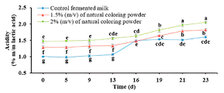
This study aimed to evaluate the influence of a powder colorant obtained from a hydroalcoholic extract of jambolan (Syzygium cumini) on the chemical, microbiological, and sensory characteristics of heat-treated flavored fermented milk. The extraction of anthocyanins from the pulp was carried out by maceration with 90% (v/v) ethanol acidified with citric acid. This extract was concentrated (14 to 15% w/v of total solids). Maltodextrin DE 12 was added to obtain 25% (w/v) total solids. Guar gum (0.06% w/w) was added as a stabilizer to whole milk reconstituted with sterilized distilled water (11% w/v total solids). The colorant powder was homogenized at a rate of 1.5 and 2 g per 100 mL of powdered whole milk dissolved in the corresponding amount of water, and sucrose and concentrated strawberry flavoring were added. The natural colorant addition allowed us to obtain a product with pH (4.23-4.75), titratable acidity (1.28-1.47% w/w lactic acid), and color stability, similar to those of yogurt with synthetic colorants. No microbial growth or color changes were detected. The judges did not notice any strange odor, taste, or color. Natural colorants can be a beneficial option for developing healthy and sustainable foods.
References
1. Rodrigues, N.R.; Pinheiro, R.; Flávio, F. Jambolan (Syzygium cumini (L.) Skeels): A review on its nutrients, bioactive compounds and health benefits. J. Food Compos. Anal. 2022, 109, 104491. https://doi.org/10.1016/j.jfca.2022.104491
2. Qamar, M.; Akhtar, S.; Ismail, T.; Wahid, M.; Abbas, M.W.; Mubarak, M.S.; Yuan, Y.; Barnard, R.T.; Ziora, Z.M.; Esatbeyoglu, T. Phytochemical profile, biological properties, and food applications of the medicinal plant Syzygium cumini. Foods 2022, 11(3), 378. https://doi.org/10.3390/foods11030378
3. Ayyanar, M.; Subash-Babu, P. Syzygium cumini (L.) Skeels: a review of its phytochemical constituents and traditional uses. Asian Pac. J. Trop. Biomed. 2012, 2(3), 240-6. https://doi.org/10.1016/S2221-1691(12)60050-1
4. Khoo, H.E.; Azlan, A.; Tang, S.T.; Lim, S.M. Anthocyanidins and anthocyanins: colored pigments as food, pharmaceutical ingredients, and the potential health benefits. Food Nutr. Res. 2017, 61(1), 1361779. https://doi.org/10.1080/16546628.2017.1361779
5. Tonon, V.; Brabet, C.; Pallet, D.; Brat, P.; Hubinger, D. Physicochemical and morphological characterization of açai powder produced with different carrier agents. Int. J. Food Sci. Technol. 2009, 44(10), 1950-58. https://doi.org/10.1111/j.1365-2621.2009.02012.x
6. Gangwar, R.; Hai, H.A.; Kumar, P.; Sharma, N.K. Development and quality evaluation of yoghurt fortified with pineapple, apple and sweet lemon juice (Fruit Yoghurt). Int. J. Eng. Res. Technol. 2016, 5(3), 621-9. https://doi.org/10.17577/IJERTV5IS030484
7. USDA-ERS. Dairy Data. Available online: https://www.ers.usda.gov/data-products/dairy-data.aspx (accessed on 15 January 2024).
8. Ścibisz, I.; Ziarno, M. Effect of fermented matrix on the color and stability of strawberry and blueberry anthocyanins during the storage of fruit yogurts and soy-based and bean-based fruit yogurt alternatives. Molecules 2023; 28(17), 6222. https://doi.org/10.3390/molecules28176222
9. Gaibor, F.M.; Cuba, A.; Rodríguez, D.; García, M.A.; Casariego, A. Optimización del proceso de extracción hidroalcohólica a partir de pulpa de cerezo negro (Syzygium cumini L. Skeels). Cienc. Tecnol. Aliment. 2017, 27(2), 51-9.
10. Singleton, V.L.; Orthofer, R.; Lamuela-Raventos, R.M. Analysis of total phenols and other oxidation substrates and antioxidants by means of Folin-Ciocalteau reagent. Method. Enzymol. 1999, 299, 152-78. https://doi.org/10.1016/S0076-6879(99)99017-1
11. Lee, J.; Durst, R.W.; Wrolstad, R.E. Determination of total monomeric anthocyanin pigment content of fruit juices, beverages, natural colorants, and wines by the pH differential method: collaborative study. J. AOAC Int. 2005, 88(5), 1269-78. PMID: 16385975.
12. Gaibor, F.M.; Rodríguez, D.; Fundora, L.; Salas, E.; Rodríguez, J.L.; Falco, A.S.; Casariego, A.; García, M.A. Evaluación de las características físicas, químicas, toxicológicas, antibacterianas y sensoriales del cerezo negro (Syzygium cumini L.). Cienc. Tecnol. Aliment. 2016, 26(2), 62-8.
13. Mercali, G.D.; Ribeiro, J.; Pez, D.; Tessaro, I.C.; Ferreira, L.D. Physical properties of acerola and blueberry pulps. J. Food Eng. 2011, 106(4), 283-289. https://doi.org/10.1016/j.jfoodeng.2011.05.010
14. Gaibor, F.M.; Rodríguez, D.; García, M.A.; Peraza, C.M.; Vidal, D.; Nogueira, A.; Casariego, A. Development of a food colorant from Syzygium cumini L. (Skeels) by spray drying. J. Food Sci. Technol. 2022, 59, 4045-55. https://doi.org/10.1007/s13197-022-05454-9
15. Powell, R.A.; Single, H.M.; Lloyd, K.R. Focus groups in mental health research: enhancing the validity of user and provider questionnaires. Int. J. Soc. Psychiatry 1996, 42(3), 193-206. https://doi.org/10.1177/002076409604200303
16. NTE-INEN 1529-10. Control microbiológico de los alimentos. Mohos y levaduras viables. Recuentos en placa por siembra en profundidad. Ecuador; 1998.
17. AOAC. Official Methods of Analysis. 21rst Edition. Association of Official Analytical Chemists, Gaithersburg, Maryland, USA; 2019.
18. Damasio, M.H.; Costell, E. Análisis Sensorial Descriptivo. Generación de descriptores y selección de catadores. Rev. Agroquim. Tecnol. Alim. 1991, 2, 165-78.
19. Silva, P.; Stringheta, P.; Teófilo, R.; Nolasco, I. Parameter optimization for spray-drying microencapsulation of jaboticaba (Myrciaria jaboticaba) peel extracts using simultaneous analysis of responses. J. Food Eng. 2013, 117(4), 538-44. http://dx.doi.org/10.1016/j.jfoodeng.2012.08.039
20. NTE-INEN 2395. Leches fermentadas. Requisitos. Ecuador; 2011.
21. Ministério da Pecuária, Agricultura e Abastecimento. Instrução Normativa n° 46, de 23 de outubro de 2007, Regulamento Técnico de Identidade e Qualidade de Leites Fermentados. Brasil. Available online: http://www.cidasc.sc.gov.br/inspecao/files/2012/08/instru%C3%87%C3%83o-normativa-n%C2%BA-46-de-23-de-outubro-de-2007.pdf (accessed on 15 January 2024).
22. Iwalokun, B.A.; Shittu, M.O. Effect of Hibiscus sabdariffa (Calyce) extract on biochemical and organoleptic properties of yogurt. Pak. J. Nutr. 2007, 6(2), 172-82. https://doi.org/10.3923/pjn.2007.172.182
23. Benchikh, Y.; Aissaoui, A.; Allouch, R.; Mohellebi, N. Optimising anthocyanin extraction from strawberry fruits using response surface methodology and application in yoghurt as natural colorants and antioxidants. J. Food Sci. Technol. 2021, 58(5), 1987-95. https://doi.org/10.1007%2Fs13197-020-04710-0
24. Barretto, F.J.F.P.; Clemente, H.A.; Santana, A.L.B.D.; Vasconcelo, M.A.S. Stability of encapsulated and non-encapsulated anthocyanin in yogurt produced with natural dye obtained from Solanum melongena L. Bark. Rev. Bras. Frutic. 2020, 42(3), e-137. http://dx.doi.org/10.1590/0100-29452020137
25. CXS 243. Norma para leches fermentadas. Codex Alimentarius. Food and Agriculture-United Nations Organization. World Health Organization; 2003.
26. Li, M.; He, Z.; He, L.; Li, C.; Tao, H.; Ye, C.; Liu, L.; Zeng, X.; Ran, G. Effect of fermentation parameters on the anthocyanin content, sensory properties, and physicochemical parameters of potato blueberry yogurt. Fermentation 2022, 8, 489. https://doi.org/10.3390/fermentation8100489
27. Faria-Oliveira, F.; Diniz, R.H.S.; Godoy-Santos, F.; Piló, F.B.; Mezadri, H.; Castro, I.M.; Brandão, R.L. The role of yeast and lactic acid bacteria in the production of fermented beverages in South America. In Food Production and Industry; Amer, A.H., Ed.; IntechOpen: London, 2015; pp. 107-35. http://dx.doi.org/10.5772/60877
28. Dangles, O.; Fenger, J.A. The chemical reactivity of anthocyanins and its consequences in Food Science and Nutrition. Molecules 2018, 7, 23(8), 1970. https://doi.org/10.3390/molecules23081970
29. Duan, C.; Xiao, X.; Yu, Y.; Xu, M.; Zhang, Y.; Liu, X.; Dai, H.; Pi, F.; Wang, J. In situ Raman characterization of the stability of blueberry anthocyanins in aqueous solutions under perturbations in temperature, UV, pH. Food Chem. 2024, 431, 137155. https://doi.org/10.1016/j.foodchem.2023.137155
Published
How to Cite
Issue
Section
Categories
License

This work is licensed under a Creative Commons Attribution 4.0 International License.
Authors who publish with BioNatura Journal agree to the following terms: Authors retain copyright and grant the BioNatura Institutional Publishing Consortium (BIPC) right of first publication with the work simultaneously licensed under a Creative Commons Attribution 4.0 International License (CC BY 4.0). This allows others to share the work with an acknowledgment of the work's authorship and initial publication in this journal.This is an open access article distributed under the terms of the Creative Commons Attribution 4.0 International License (CC BY 4.0), which permits unrestricted use, distribution, and reproduction in any medium, provided the original work is properly cited.
